Fish profile · Sparidae
Australasian snapper
Chrysophrys auratus
Also called Pink snapper, Squire, and Red bream
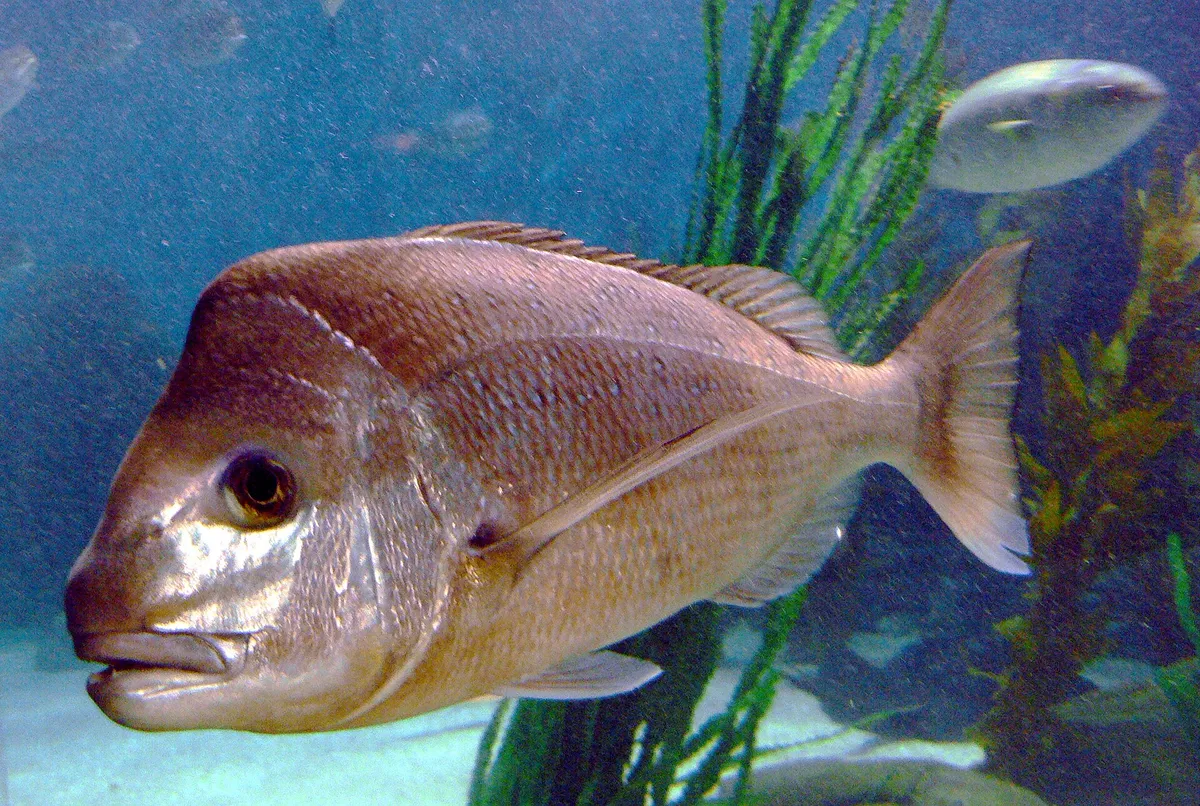
The Australasian snapper, also called pink snapper, is one of the best-known food and sport fish of southern Australia and New Zealand. Large adults grow a hump on the head.
Last reviewed 13 November 2026 · 4 sources
How big?
Linear scale · person 170 cm
- Max length
- 130 cm
- Max weight
- 20 kg
How to identify
- Pink above and silvery white below
- Fine bright blue spots on the upper sides, fewer in large fish
- Large adults of both sexes grow a hump on the head
Environment
- Water
- Saltwater
- Zone
- Around reefs
- Depth
- 1–200 m
EstuariesCoastal watersReefsOpen ocean
Young fish and small adults live in bays, inlets and estuaries. Adults are usually offshore near rocky reefs.
- Diet
- Small young fish eat small crustaceans, crabs and worms. Adults eat small fish and hard-shelled animals, which they crush with their strong teeth.
Distribution
- Native
- Australian waters from about Townsville in Queensland round the south to Cape Cuvier in Western Australia, plus Lord Howe and Norfolk Islands. Also New Zealand.
Where it's been recorded
Recorded in 6 countries: Australia, China, Indonesia, New Zealand, Norfolk Island, and Taiwan.
Records from GBIF.org, CC0 and CC BY datasets only. Few records can mean few surveys, not few fish.
Eating
The flesh is of excellent quality.
Status and uses
Taxonomy
- KingdomAnimalia
- PhylumChordata
- SubphylumVertebrata
- InfraphylumGnathostomata
- ParvphylumOsteichthyes
- GigaclassActinopterygii
- SuperclassActinopteri
- ClassTeleostei
- FamilySparidae
- GenusChrysophrys
- SpeciesChrysophrys auratus (Forster, 1801)
Names in other languages
Names from Wikidata and Malaysian fisheries lists. Each is tagged with its language.
| Language | Names | Source |
|---|---|---|
| Chinese | 银金鲷, 銀金鯛, 金鯛 | wikidata.org |
| Arabic | قجاج أسترالي | wikidata.org |
| Egyptian Arabic | قجاج استرالى | wikidata.org |
| Japanese | ゴウシュウマダイ | wikidata.org |
| Korean | 금색돔 | wikidata.org |
| Lithuanian | Naujosios Zelandijos jūrinis karosas | wikidata.org |
Sources
Last reviewed 13 November 2026
- Chrysophrys auratusfishesofaustralia.net.au
- Chrysophrys auratus (Forster, 1801)catalogueoflife.org
- Pagrus auratus (Forster, 1801)gbif.org
- Australasian snapperwikidata.org
Photo credits

Data credits
- IUCN Red List category, via GBIF (CC BY 4.0).
- Range map from records on GBIF.org (CC0 and CC BY datasets only).
- Classification from Catalogue of Life (CC BY 4.0).