Fish profile · Aspredinidae
Banjo catfish
Bunocephalus coracoideus
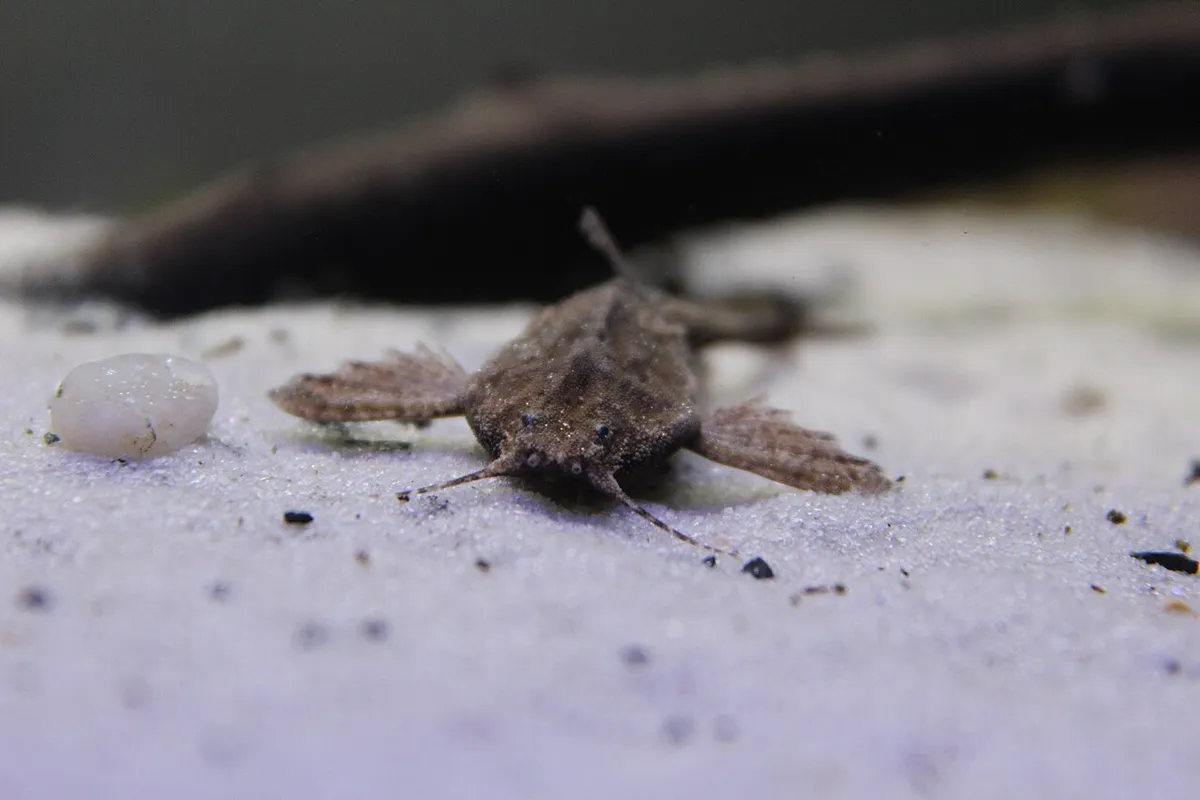
The banjo catfish, or guitarrito, is a flat, leaf-brown catfish of the Amazon basin that lies camouflaged among plant debris. It is a popular aquarium fish.
Last reviewed 23 November 2026 · 4 sources
How big?
Linear scale · hand 18 cm
- Max length
- 11 cm
- without the tail
How to identify
- A flat, brown, banjo-shaped body that blends in with dead leaves and plant debris.
Environment
- Water
- Freshwater
Ponds and creeks full of plant debris.
- Diet
- Debris from the bottom and smaller fish. It feeds mostly at night.
Distribution
- Native
- The Amazon River basin, in Bolivia, Brazil, Peru and Uruguay.
Where it's been recorded
Recorded in 8 countries: Bolivia, Brazil, Colombia, French Guiana, Peru, Suriname, Uruguay, and Venezuela.
Records from GBIF.org, CC0 and CC BY datasets only. Few records can mean few surveys, not few fish.
Status and uses
IUCN Red List: Least Concern (LC)
Category from the IUCN Red List; it may lag the latest assessment.
Uses: Aquarium
Taxonomy
- KingdomAnimalia
- PhylumChordata
- SubphylumVertebrata
- InfraphylumGnathostomata
- ParvphylumOsteichthyes
- GigaclassActinopterygii
- SuperclassActinopteri
- ClassTeleostei
- OrderSiluriformes
- SuborderSiluroidei
- FamilyAspredinidae
- SubfamilyAspredininae
- GenusBunocephalus
- SpeciesBunocephalus coracoideus (Cope, 1874)
Types: Types of catfish
Names in other languages
Names from Wikidata and Malaysian fisheries lists. Each is tagged with its language.
| Language | Names | Source |
|---|---|---|
| Chinese | 雙色丘頭鯰 | wikidata.org |
| Finnish | kyhmybanjomonni | wikidata.org |
| Polish | Drewniak dwubarwny | wikidata.org |
| Spanish | Carachita, Guitarrita, Sapo cunshi | wikidata.org |
Sources
Last reviewed 23 November 2026
Photo credits

Data credits
- IUCN Red List category, via GBIF (CC BY 4.0).
- Range map from records on GBIF.org (CC0 and CC BY datasets only).
- Classification from Catalogue of Life (CC BY 4.0).