Fish profile · Dasyatidae
Bluespotted ribbontail ray
Taeniura lymma
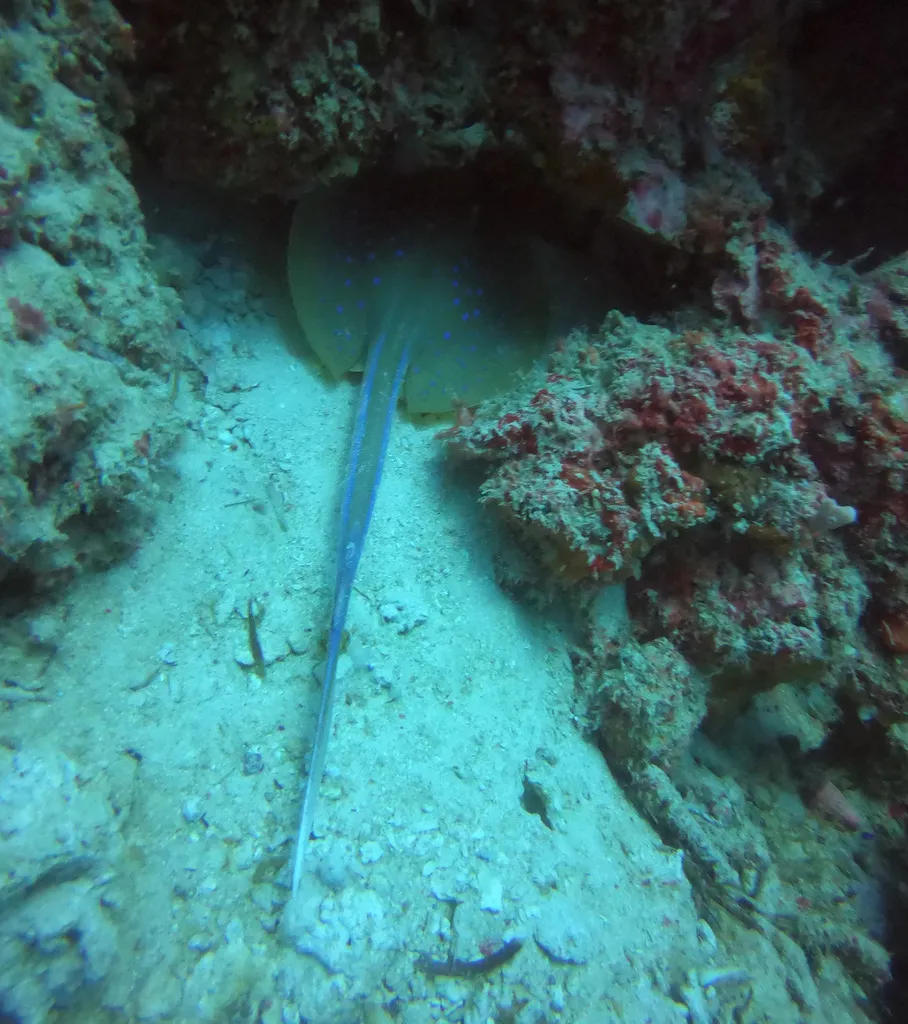
The bluespotted ribbontail ray is a small reef stingray with bright blue spots and two blue stripes on its tail. It is common on Indo-Pacific reefs and sold as an aquarium fish, but it seldom lives long in a tank.
Last reviewed 23 November 2026 · 4 sources
How big?
- Max width
- 35 cm
- across the body, not the tail
How to identify
- A small, oval disc with large, protruding eyes.
- Bright electric-blue spots on a yellowish background, with a pair of blue stripes on the tail.
- It is easy to confuse with Kuhl's maskray; the ribbontail has a rounder body and brighter blue spots.
Look-alikes
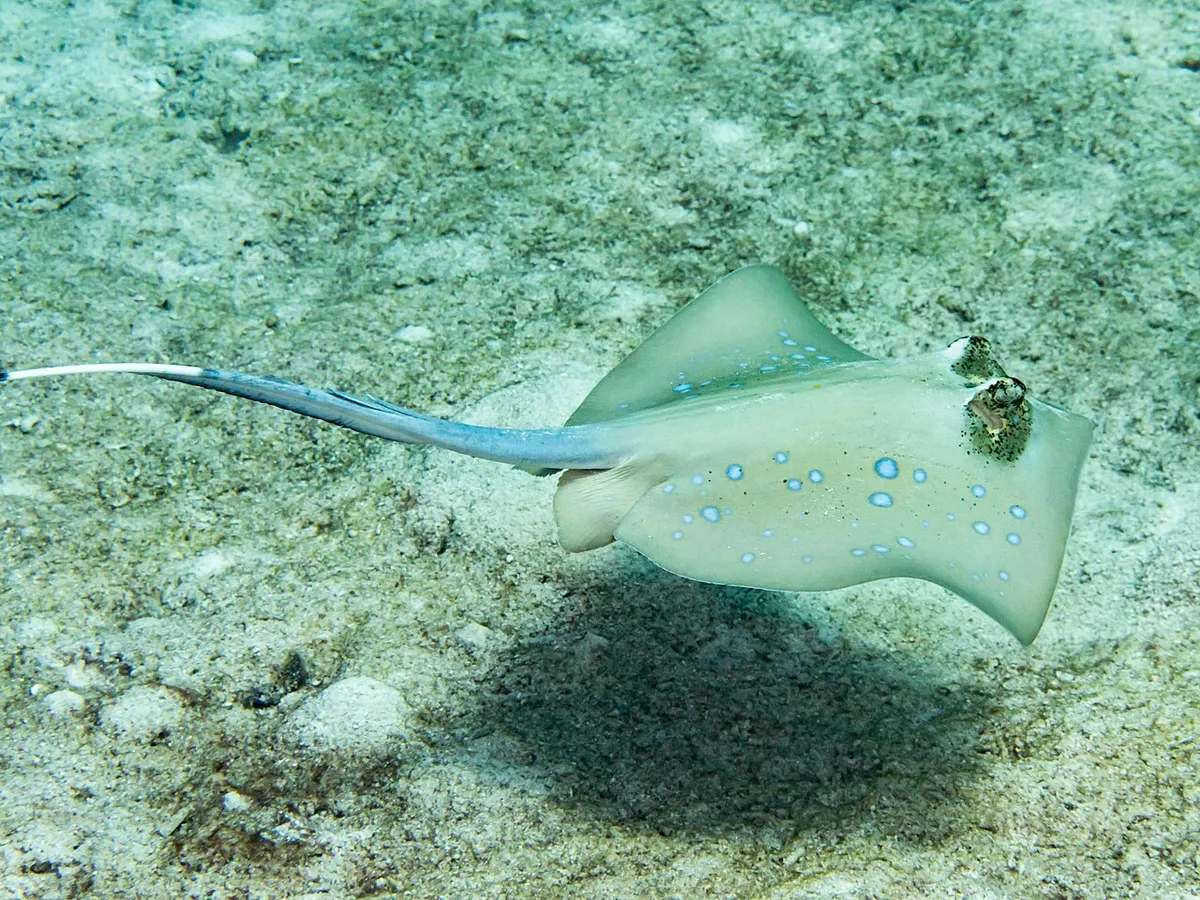 Bluespotted maskray
The maskray is larger, with a more angular disc and duller green body, and a dark mask-like patch around the eyes.
Environment
- Water
- Saltwater
- Depth
- 0–30 m
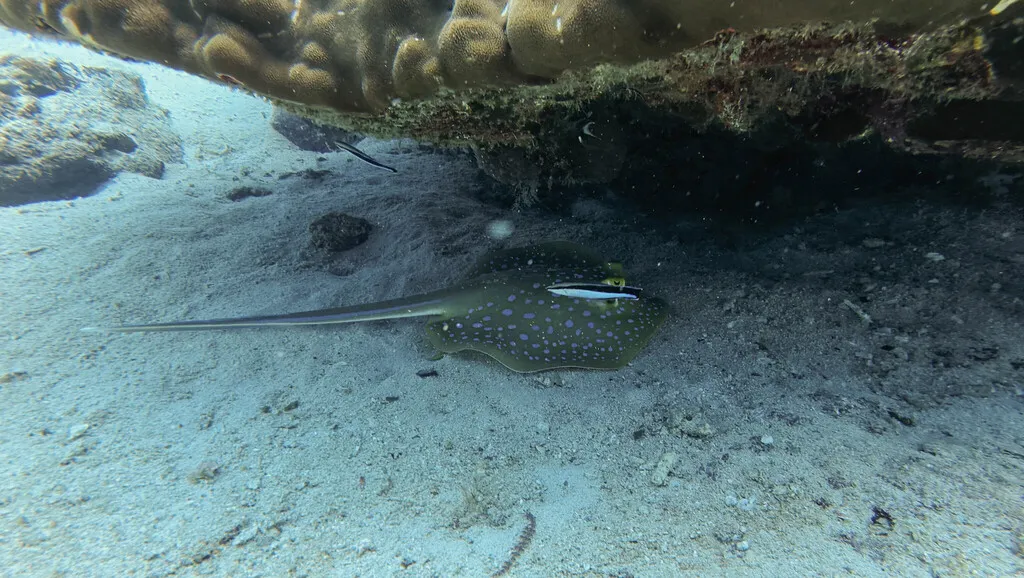
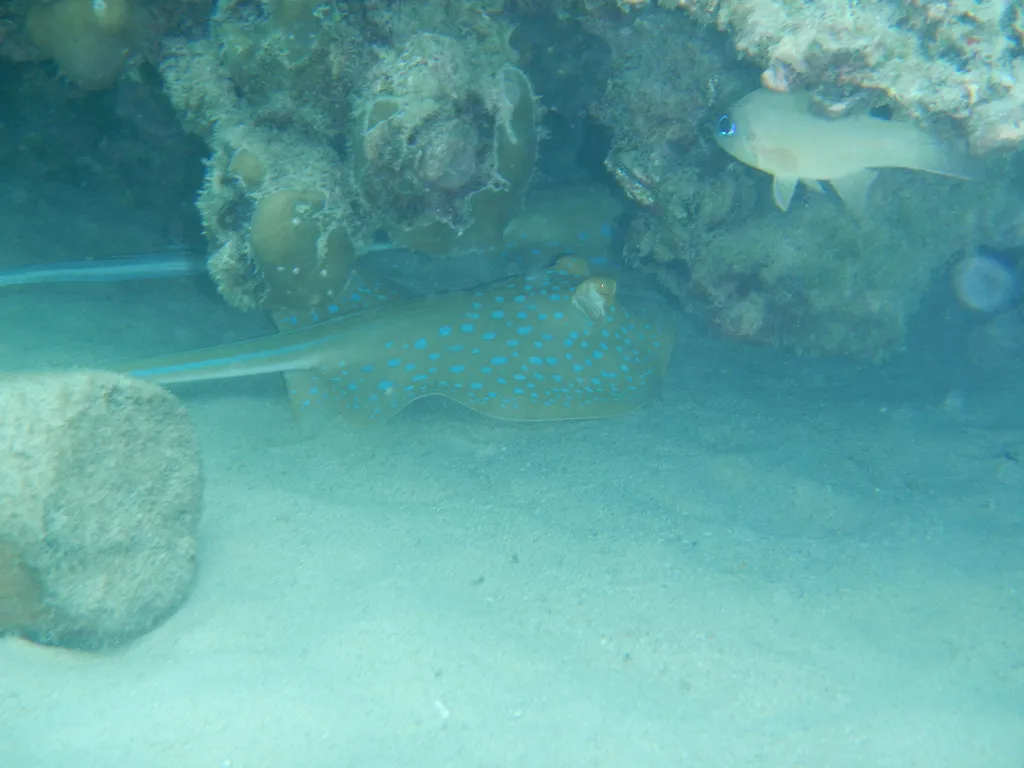
Coral reefs and nearby sandy flats, tide pools and seagrass. By day it hides under ledges or in caves; at night it moves onto sandy flats on the rising tide.
- Diet
- Molluscs, worms, shrimps, crabs and small bony fish dug from the sand.
Distribution
- Native
- Nearshore waters of the tropical Indo-Pacific, from South Africa and the Arabian Peninsula through Southeast Asia to the Philippines, northern Australia and islands as far east as the Solomon Islands.
Where it's been recorded
Recorded in 34 countries: Australia, Djibouti, Ecuador, Egypt, Eritrea, Fiji, French Polynesia, French Southern Territories, India, Indonesia, Israel, Kenya, Madagascar, Malaysia, Maldives, Mayotte, Mozambique, New Caledonia, Oman, Papua New Guinea, Philippines, Réunion, Saudi Arabia, Seychelles, Singapore, Solomon Islands, South Africa, Sudan, Tanzania, Thailand, United States, Vanuatu, Wallis & Futuna, and Yemen.
Records from GBIF.org, CC0 and CC BY datasets only. Few records can mean few surveys, not few fish.
Eating
Eaten in East Africa, Southeast Asia and Australia, and caught in gillnets, on longlines and in traps.
Status and uses
Taxonomy
- KingdomAnimalia
- PhylumChordata
- SubphylumVertebrata
- InfraphylumGnathostomata
- ParvphylumChondrichthyes
- ClassElasmobranchii
- SubclassNeoselachii
- InfraclassBatoidea
- OrderMyliobatiformes
- FamilyDasyatidae
- GenusTaeniura
- SpeciesTaeniura lymma (Fabricius, 1775)
Types: Types of stingrays
Names in other languages
Names from Wikidata and Malaysian fisheries lists. Each is tagged with its language.
| Language | Names | Source |
|---|---|---|
| Malay | pari karang | wikidata.org |
| Chinese | 蓝斑条尾魟, 藍斑條尾魟 | wikidata.org |
| Afrikaans | Bloukol-lintstertrog | wikidata.org |
| Arabic | لما | wikidata.org |
| Bulgarian | Синьопетнист лентоопашат скат | wikidata.org |
| Cebuano | Kiampao | wikidata.org |
| Czech | trnucha modroskvrnná | wikidata.org |
| Dutch | blauwgespikkelde pijlstaartrog | wikidata.org |
| Egyptian Arabic | لما | wikidata.org |
| French | Raie pastenague à points bleus | wikidata.org |
Show 12 more languages
| German | Blaupunktrochen | wikidata.org |
|---|---|---|
| Hebrew | מחבטן הספירים | wikidata.org |
| Hungarian | kékpettyes tüskésrája | wikidata.org |
| Indonesian | Pari tutul-biru ekor-pita | wikidata.org |
| Japanese | ルリホシエイ | wikidata.org |
| Korean | 꽁지가오리 | wikidata.org |
| Macedonian | синоточкеста лентоопашеста ража | wikidata.org |
| Polish | Patelnica niebieskoplama | wikidata.org |
| Russian | Тэниура-лимма | wikidata.org |
| Slovenian | modropikasti morski bič | wikidata.org |
| Thai | ปลากระเบนทอง | wikidata.org |
| Vietnamese | Cá đuối chấm xanh | wikidata.org |
More photos
Sources
Last reviewed 23 November 2026
- Taeniura lymma (Fabricius, 1775)catalogueoflife.org
- Taeniura lymma (Forsskål, 1775)gbif.org
- bluespotted ribbontail raywikidata.org
- Bluespotted ribbontail rayen.wikipedia.org
Photo credits
- Photo 1, top of the page: (c) portioid, some rights reserved (CC BY) · CC BY · Source
- Photo 2: (c) Niko Ioannidis, some rights reserved (CC BY) · CC BY · Source
- Photo 3: (c) Isaac Krone, some rights reserved (CC BY) · CC BY · Source
- Bluespotted maskray, in look-alikes: Rickard Zerpe / Wikimedia Commons · CC BY · Source

Data credits
- IUCN Red List category, via GBIF (CC BY 4.0).
- Range map from records on GBIF.org (CC0 and CC BY datasets only).
- Classification from Catalogue of Life (CC BY 4.0).