Fish profile · Loricariidae
Bristlenose pleco
Ancistrus cirrhosus
Bristlenose plecos are small, bumpy-plated suckermouth catfish of the genus Ancistrus. Adult males grow fleshy tentacles on the snout, which give the group its name.
Last reviewed 23 November 2026 · 4 sources
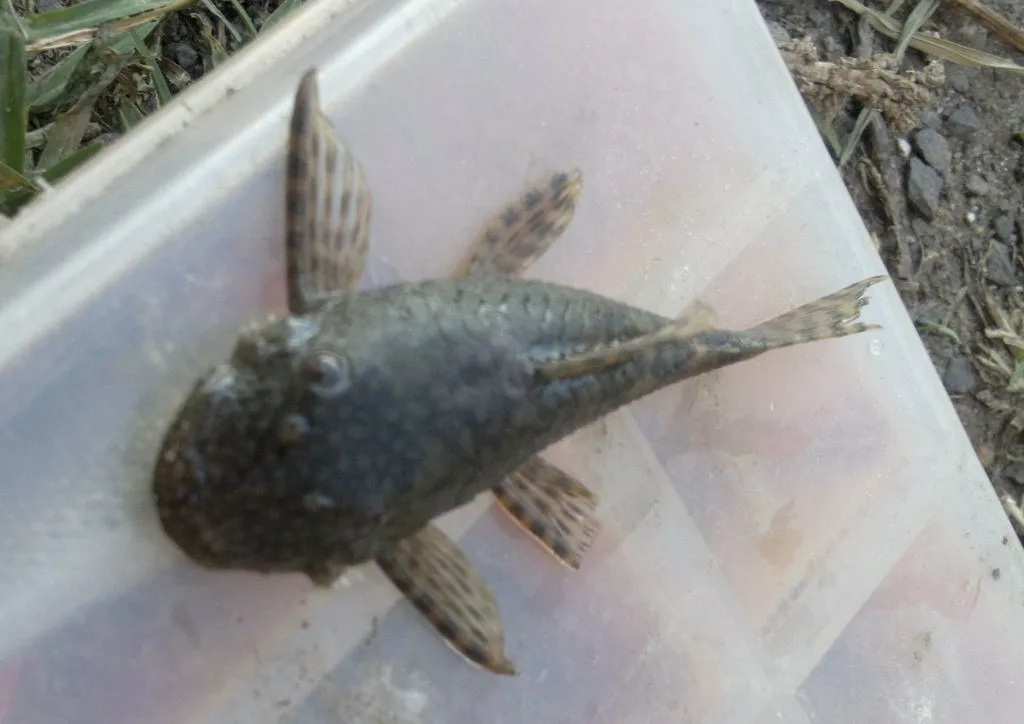
How to identify
- A body covered in bony plates and a suckermouth underneath.
- Adult males have fleshy tentacles on the head. Females have smaller ones along the snout edge, or none.
- Often called pleco, but that name usually means Hypostomus and its relatives.
Environment
- Water
- Freshwater
Freshwater habitats across South America. Bristlenose catfish are active mostly at night.
Distribution
- Native
- Freshwater habitats in South America and Panama (the genus Ancistrus).
Where it's been recorded
Recorded in 9 countries: Argentina, Bolivia, Brazil, French Guiana, Guadeloupe, Guyana, Paraguay, Peru, and Uruguay.
Records from GBIF.org, CC0 and CC BY datasets only. Few records can mean few surveys, not few fish.
Status and uses
IUCN Red List: Least Concern (LC)
Category from the IUCN Red List; it may lag the latest assessment.
Uses: Aquarium
Taxonomy
- KingdomAnimalia
- PhylumChordata
- SubphylumVertebrata
- InfraphylumGnathostomata
- ParvphylumOsteichthyes
- GigaclassActinopterygii
- SuperclassActinopteri
- ClassTeleostei
- OrderSiluriformes
- SuborderSiluroidei
- FamilyLoricariidae
- SubfamilyHypostominae
- TribeAncistrini
- GenusAncistrus
- SpeciesAncistrus cirrhosus (Valenciennes, 1836)
Types: Types of catfish
Names in other languages
Names from Wikidata and Malaysian fisheries lists. Each is tagged with its language.
| Language | Names | Source |
|---|---|---|
| Chinese | 鬚鈎鯰 | wikidata.org |
| Bulgarian | тъмен анциструс | wikidata.org |
| Czech | krunýřovec skvrnitý | wikidata.org |
| Estonian | kähar harjasnina | wikidata.org |
| Finnish | täpläpartamonni | wikidata.org |
| Lithuanian | Tamsusis šeriasnukis | wikidata.org |
| Russian | Усатый сомик-анцистр | wikidata.org |
| Ukrainian | Анциструс темний | wikidata.org |
Sources
Last reviewed 23 November 2026
Photo credits
Data credits
- IUCN Red List category, via GBIF (CC BY 4.0).
- Range map from records on GBIF.org (CC0 and CC BY datasets only).
- Classification from Catalogue of Life (CC BY 4.0).