Fish profile · Cyprinidae
Catla
Labeo catla
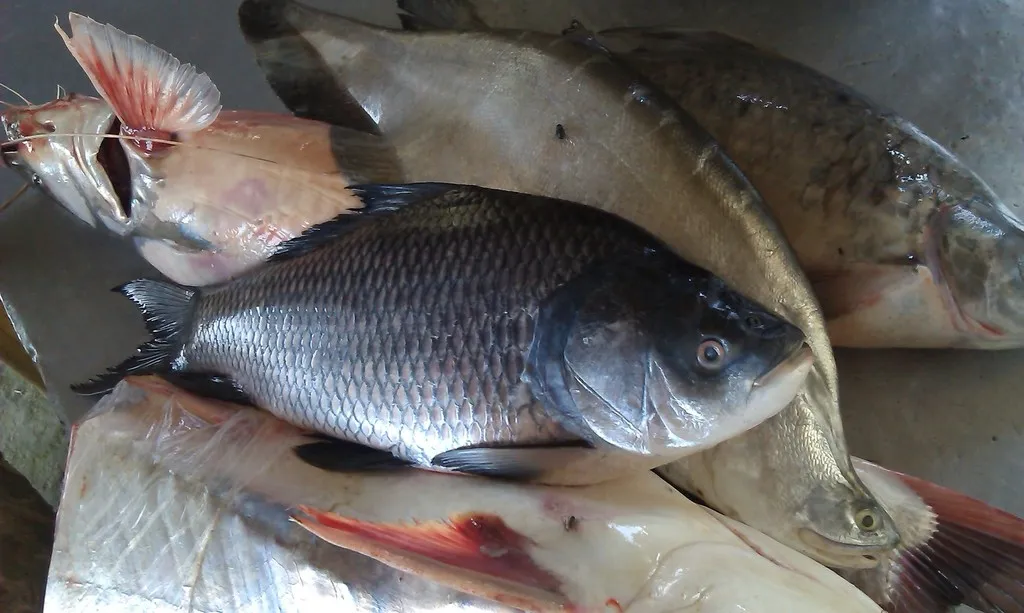
The catla is a big South Asian carp with a broad head and upturned mouth. It is one of the most important farmed freshwater fish in South Asia.
Last reviewed 18 November 2026 · 4 sources
How big?
Linear scale · person 170 cm
- Max length
- 182 cm
- Max weight
- 38.6 kg
How to identify
- A large, broad head with a protruding lower jaw and an upturned mouth.
- Large greyish scales on the back and a whitish belly.
Environment
- Water
- Freshwater
A surface and mid-water feeder.
- Diet
- Adults eat zooplankton, which they filter with large gill rakers. Young fish also take phytoplankton.
Distribution
- Native
- Rivers and lakes of northern India, Bangladesh, Myanmar, Nepal and Pakistan.
- Introduced
- Elsewhere in South Asia, where it is commonly farmed.
Where it's been recorded
Recorded in 6 countries: Bangladesh, India, Myanmar (Burma), Pakistan, Thailand, and Vietnam.
Records from GBIF.org, CC0 and CC BY datasets only. Few records can mean few surveys, not few fish.
Eating
Sold fresh and carried on ice. Fish of 1–2 kg are preferred.
Status and uses
IUCN Red List: Least Concern (LC)
Category from the IUCN Red List; it may lag the latest assessment.
Uses: Food
Taxonomy
- KingdomAnimalia
- PhylumChordata
- SubphylumVertebrata
- InfraphylumGnathostomata
- ParvphylumOsteichthyes
- GigaclassActinopterygii
- SuperclassActinopteri
- ClassTeleostei
- OrderCypriniformes
- FamilyCyprinidae
- SubfamilyLabeoninae
- GenusLabeo
- SpeciesLabeo catla (Hamilton, 1822)
More photos
Sources
Last reviewed 18 November 2026
- Catlaen.wikipedia.org
- Labeo catla (Hamilton, 1822)catalogueoflife.org
- Gibelion catla (Hamilton, 1822)gbif.org
- Gibelion catlawikidata.org
Photo credits
Data credits
- IUCN Red List category, via GBIF (CC BY 4.0).
- Range map from records on GBIF.org (CC0 and CC BY datasets only).
- Classification from Catalogue of Life (CC BY 4.0).