Fish profile · Leiognathidae
Common ponyfish
Leiognathus equulus
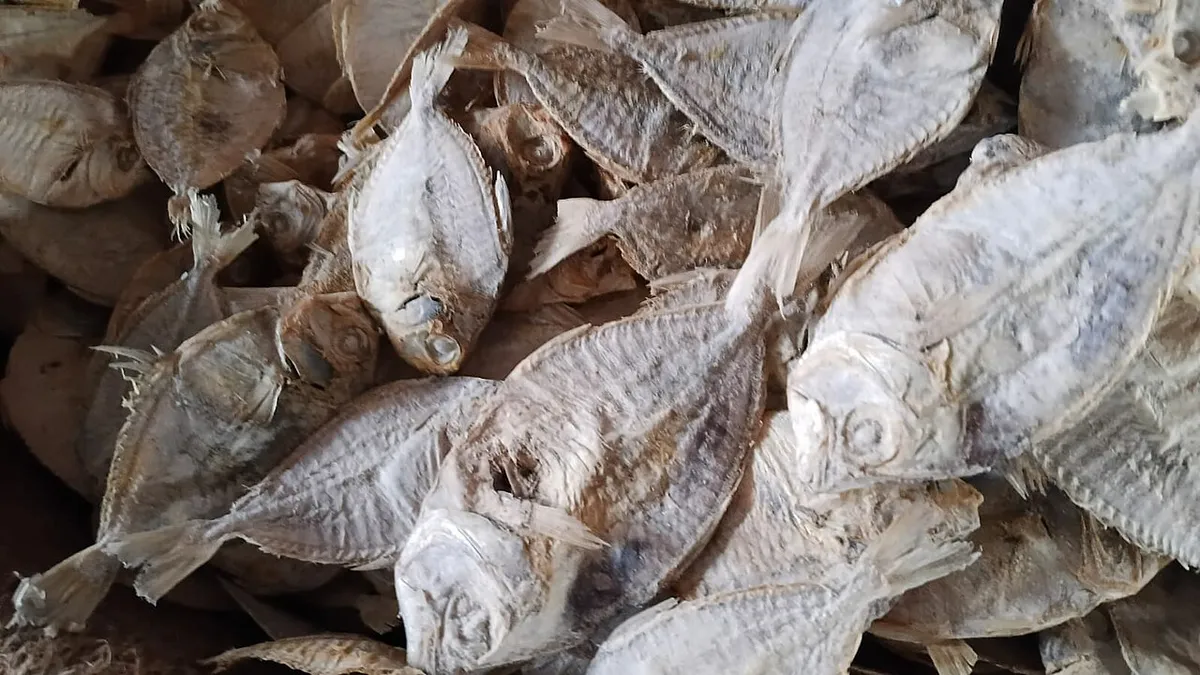
The common ponyfish is a silvery, deep-bodied fish of Indo-West Pacific seas and estuaries, with a mouth that shoots forward. It is one of the largest ponyfishes.
Last reviewed 23 November 2026 · 4 sources
How big?
Linear scale · hand 18 cm
- Max length
- 24 cm
How to identify
- Ponyfishes have a highly protractile mouth that extends forward and downward.
- Several similar-looking ponyfish species make this one hard to tell apart, so older records can mix them up.
Environment
- Depth
- 10–200 m
Coastal water, river mouths, brackish and fresh water, mostly in the sea at 10 to 200 m.
- Diet
- Small bottom-living invertebrates and plankton, including worms.
Distribution
- Native
- The Red Sea, Persian Gulf and Indo-West Pacific, including the east coast of Africa, southern Japan, Taiwan, southern China, Queensland, New Caledonia and islands from the Marianas to Samoa.
Where it's been recorded
Recorded in 41 countries: Australia, Bahrain, Bangladesh, Brunei, Cambodia, China, Egypt, Fiji, Guam, Hong Kong SAR China, India, Indonesia, Iraq, Japan, Kenya, Kuwait, Madagascar, Malaysia, Mauritius, Mayotte, Micronesia, Mozambique, Myanmar (Burma), New Caledonia, Pakistan, Palau, Papua New Guinea, Philippines, Réunion, Samoa, Seychelles, Singapore, Solomon Islands, South Africa, Sri Lanka, Taiwan, Tanzania, Thailand, Vanuatu, Vietnam, and Yemen.
Records from GBIF.org, CC0 and CC BY datasets only. Few records can mean few surveys, not few fish.
Status and uses
IUCN Red List: Least Concern (LC)
Category from the IUCN Red List; it may lag the latest assessment.
Uses: Food
Taxonomy
- KingdomAnimalia
- PhylumChordata
- SubphylumVertebrata
- InfraphylumGnathostomata
- ParvphylumOsteichthyes
- GigaclassActinopterygii
- SuperclassActinopteri
- ClassTeleostei
- OrderGerriformes
- FamilyLeiognathidae
- GenusLeiognathus
- SpeciesLeiognathus equulus (Forsskål, 1775)
Sources
Last reviewed 23 November 2026
Photo credits

Data credits
- IUCN Red List category, via GBIF (CC BY 4.0).
- Range map from records on GBIF.org (CC0 and CC BY datasets only).
- Classification from Catalogue of Life (CC BY 4.0).