Fish profile · Epinephelidae
Humpback grouper
Cromileptes altivelis
Also called Panther grouper and Barramundi cod
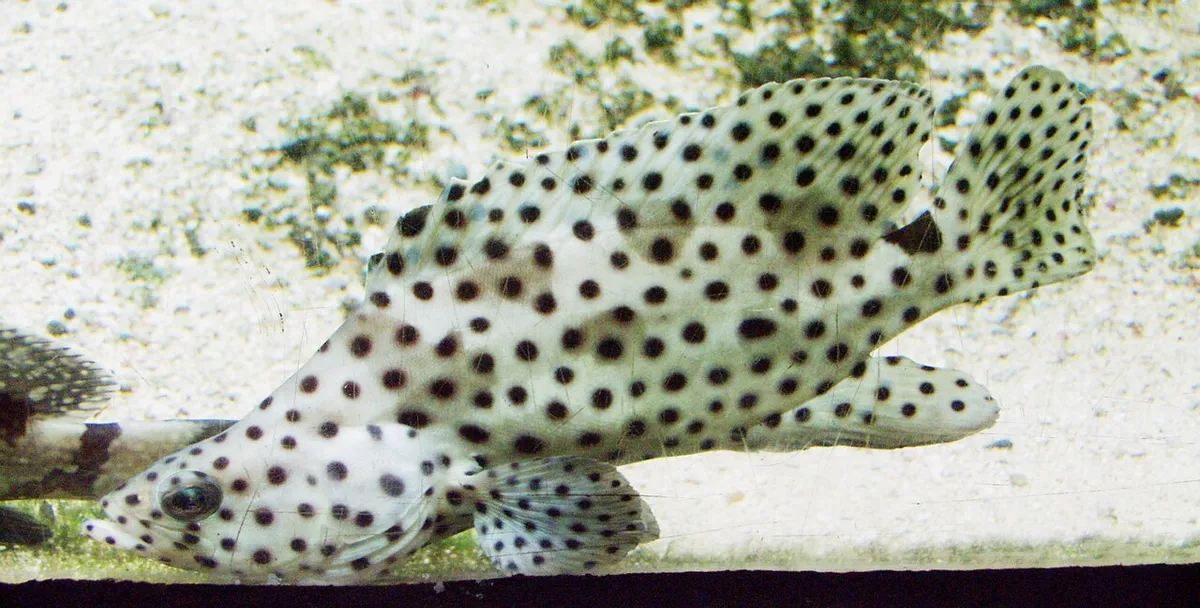
The humpback grouper is a spotted reef grouper named for the dip and hump on its head. It is a highly valued food fish in Southeast Asia, farmed mainly in Taiwan and Indonesia, and popular in live fish markets and aquariums.
Last reviewed 18 November 2026 · 4 sources
How big?
Linear scale · person 170 cm
- Max length
- 70 cm
How to identify
- A laterally flattened, tall body, with the head dipped in front and raised at the nape: the "hump".
- Young fish are white with round black spots. Adults are grey and beige with darker blotches and small black spots.
Environment
- Water
- Saltwater
- Zone
- Around reefs
- Depth
- 2–40 m
Clear water from lagoons to seaward reefs, preferring dead or silty areas. Usually shallower than 10 m.
- Diet
- Small fish and crustaceans such as shrimp, squid and clams. It ambushes its prey, most active at dawn and dusk.
Distribution
- Native
- Tropical waters of the central Indo-West Pacific.
Where it's been recorded
Recorded in 18 countries: Australia, French Polynesia, India, Indonesia, Japan, Malaysia, Marshall Islands, Mauritius, New Caledonia, Palau, Philippines, Singapore, Solomon Islands, Taiwan, Thailand, U.S. Outlying Islands, United States, and Vietnam.
Records from GBIF.org, CC0 and CC BY datasets only. Few records can mean few surveys, not few fish.
Eating
Sold live in markets across Asia, mainly Hong Kong. Large predators like it can carry ciguatera poison.
Status and uses
Taxonomy
- KingdomAnimalia
- PhylumChordata
- SubphylumVertebrata
- InfraphylumGnathostomata
- ParvphylumOsteichthyes
- GigaclassActinopterygii
- SuperclassActinopteri
- ClassTeleostei
- OrderPerciformes
- SuborderPercoidei
- FamilyEpinephelidae
- GenusCromileptes
- SpeciesCromileptes altivelis (Valenciennes, 1828)
Sources
Last reviewed 18 November 2026
- Humpback grouperen.wikipedia.org
- Cromileptes altivelis (Valenciennes, 1828)gbif.org
- Cromileptes altivelis (Valenciennes, 1828)catalogueoflife.org
- Chromileptes altivelis (Valenciennes, 1828)catalogueoflife.org
Photo credits

Data credits
- Range map from records on GBIF.org (CC0 and CC BY datasets only).
- Classification from Catalogue of Life (CC BY 4.0).