Fish profile · Scombridae
Little tunny
Euthynnus alletteratus
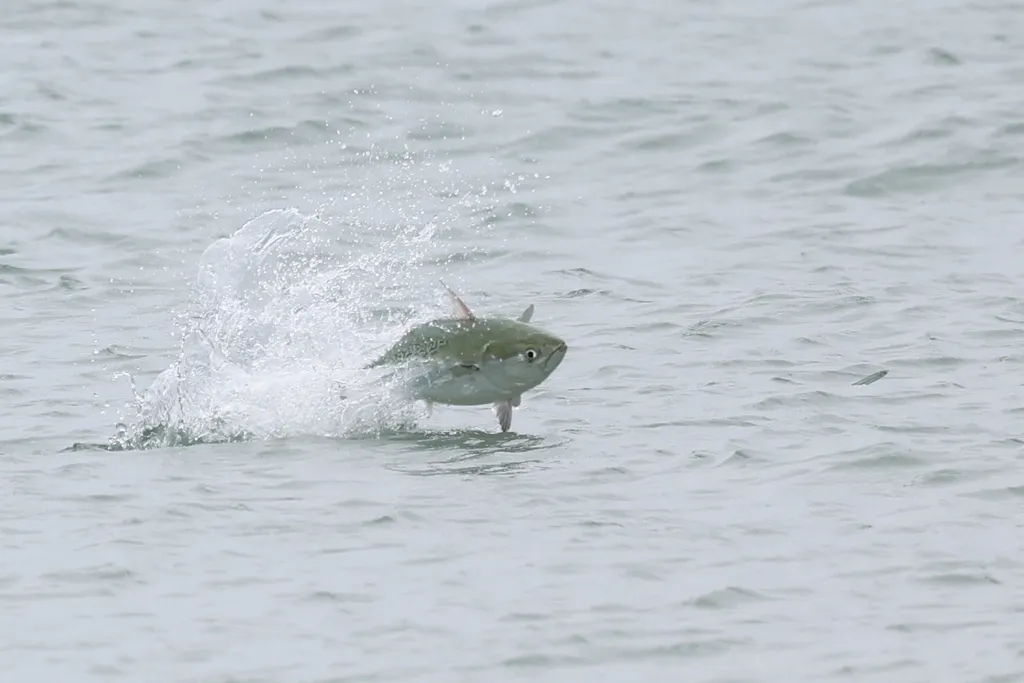
The little tunny is a small, fast tuna of the Atlantic and Mediterranean, often called false albacore. It is a hard-fighting sport fish but is rarely eaten, because its meat is strongly flavoured.
Last reviewed 23 November 2026 · 4 sources
How big?
Linear scale · person 170 cm
- Max length
- 100 cm
- to the fork of the tail
- Max weight
- 12 kg
How to identify
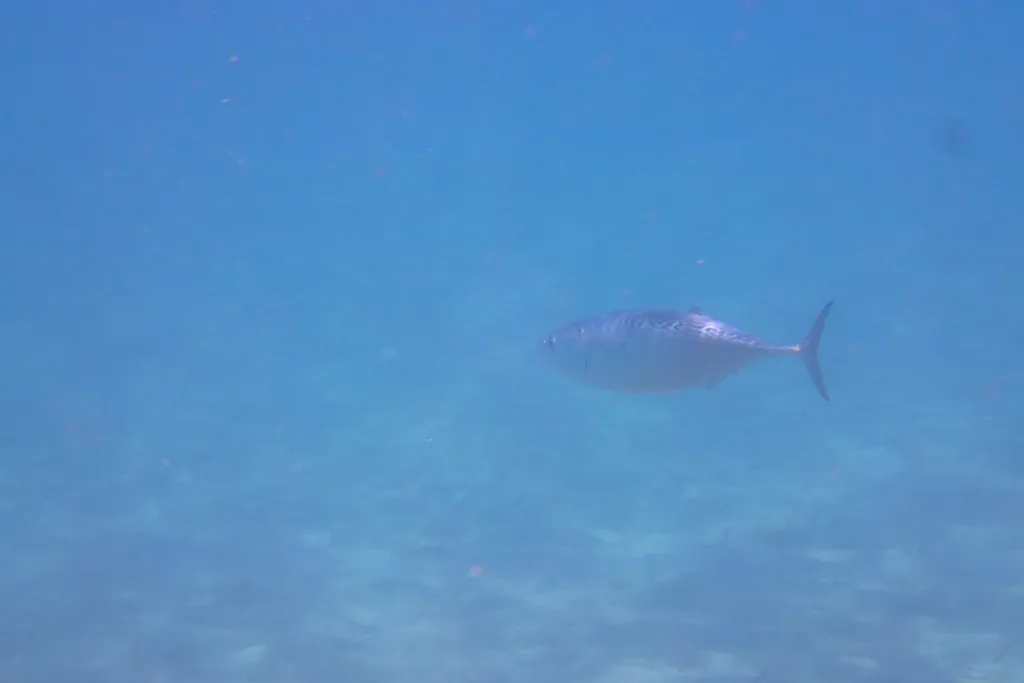
- Worm-like wavy lines on the back, ending before the middle of the first dorsal fin.
- Three to seven dark, fingerprint-like spots between the pectoral and pelvic fins, which no other Atlantic tuna has.
- A bright white belly and a torpedo-shaped body.
Environment
Distribution
- Native
- The Atlantic Ocean and the Mediterranean and Black seas. In the western Atlantic it ranges from Brazil to New England.
Where it's been recorded
Recorded in 55 countries: Algeria, Angola, Anguilla, Bangladesh, Belize, Benin, Brazil, British Indian Ocean Territory, British Virgin Islands, Canada, Cape Verde, Colombia, Comoros, Congo - Brazzaville, Côte d’Ivoire, Croatia, Equatorial Guinea, France, French Guiana, French Southern Territories, Gabon, Ghana, Greece, Guadeloupe, Guinea, Guinea-Bissau, Honduras, India, Israel, Italy, Japan, Lebanon, Liberia, Madagascar, Martinique, Mauritania, Mexico, Nicaragua, Nigeria, Peru, Puerto Rico, São Tomé & Príncipe, Senegal, Seychelles, Sierra Leone, South Africa, Spain, Sri Lanka, St. Barthélemy, Sweden, Taiwan, Trinidad & Tobago, Tunisia, Türkiye, and United States.
Records from GBIF.org, CC0 and CC BY datasets only. Few records can mean few surveys, not few fish.
Eating
Many people consider it a rough fish because of its strong taste and the work needed to prepare it. It is also used as bait for sharks and marlin.
Status and uses
Taxonomy
- KingdomAnimalia
- PhylumChordata
- SubphylumVertebrata
- InfraphylumGnathostomata
- ParvphylumOsteichthyes
- GigaclassActinopterygii
- SuperclassActinopteri
- ClassTeleostei
- OrderScombriformes
- SuborderScombroidei
- FamilyScombridae
- SubfamilyScombrinae
- GenusEuthynnus
- SpeciesEuthynnus alletteratus (Rafinesque, 1810)
Types: Types of tuna
Names in other languages
Names from Wikidata and Malaysian fisheries lists. Each is tagged with its language.
| Language | Names | Source |
|---|---|---|
| Chinese | 小鲔, 小鮪 | wikidata.org |
| Afrikaans | Atlantiese kleintuna | wikidata.org |
| Arabic | كبريت | wikidata.org |
| Asturian | bonitu zurdu, rayáu | wikidata.org |
| Basque | Lanpo bularpikart | wikidata.org |
| Bulgarian | петнист тунец | wikidata.org |
| Czech | tuňák malý | wikidata.org |
| Dutch | Dwergtonijn | wikidata.org |
| Egyptian Arabic | كبريت | wikidata.org |
| French | Bonite, Bonite queue Raide, Ravil, Thonine, Thonine Commune | wikidata.org |
Show 10 more languages
| Galician | Bacoreta | wikidata.org |
|---|---|---|
| German | Thonine | wikidata.org |
| Indonesian | Sembak | wikidata.org |
| Japanese | タイセイヨウヤイト | wikidata.org |
| Norwegian Bokmål | tunnin | wikidata.org |
| Norwegian Nynorsk | tunnin | wikidata.org |
| Spanish | Bonito, Atuncito, Bacoreta, Bacorète, Cabaña Pintada, Carachana, Carachana Pintada, Comevíveres | wikidata.org |
| Swedish | Tunnina | wikidata.org |
| Ukrainian | Тунець малий | wikidata.org |
| Welsh | Tiwna Bach | wikidata.org |
More photos
Sources
Last reviewed 23 November 2026
- Euthynnus alletteratus (Rafinesque, 1810)catalogueoflife.org
- Euthynnus alletteratus (Rafinesque, 1810)gbif.org
- little tunnywikidata.org
- Little tunnyen.wikipedia.org
Photo credits
Data credits
- IUCN Red List category, via GBIF (CC BY 4.0).
- Range map from records on GBIF.org (CC0 and CC BY datasets only).
- Classification from Catalogue of Life (CC BY 4.0).