Fish profile · Chanidae
Milkfish
Chanos chanos
The milkfish, called bangus in the Philippines, is a silvery, toothless Indo-Pacific fish farmed across Southeast Asia. It is very bony and often sold deboned.
Last reviewed 24 November 2026 · 7 sources
How big?
Linear scale · person 170 cm
- Max length
- 180 cm
- usually 100 cm
- Max weight
- 19 kg
How to identify
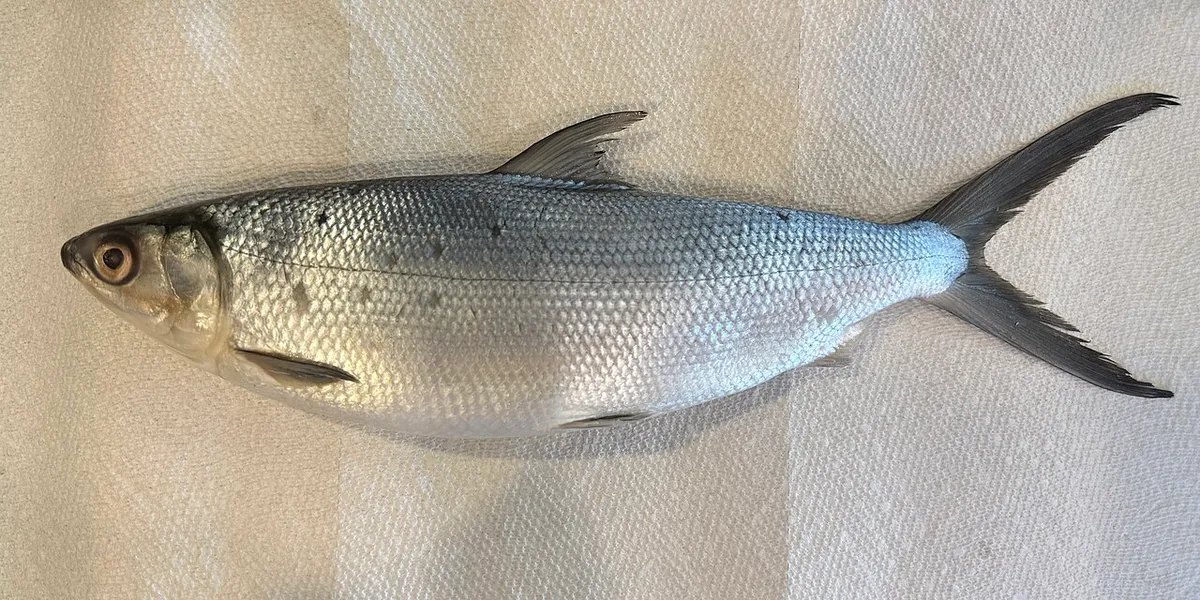
- A long, streamlined body that is slightly flattened from side to side, olive green above with silvery sides and dark-edged fins.
- A small head and a small toothless mouth, one dorsal fin and a large forked tail.
- No scutes along the belly, and a small bump on the lower jaw. These tell it apart from herring-like fish and tarpon.
Look-alikes
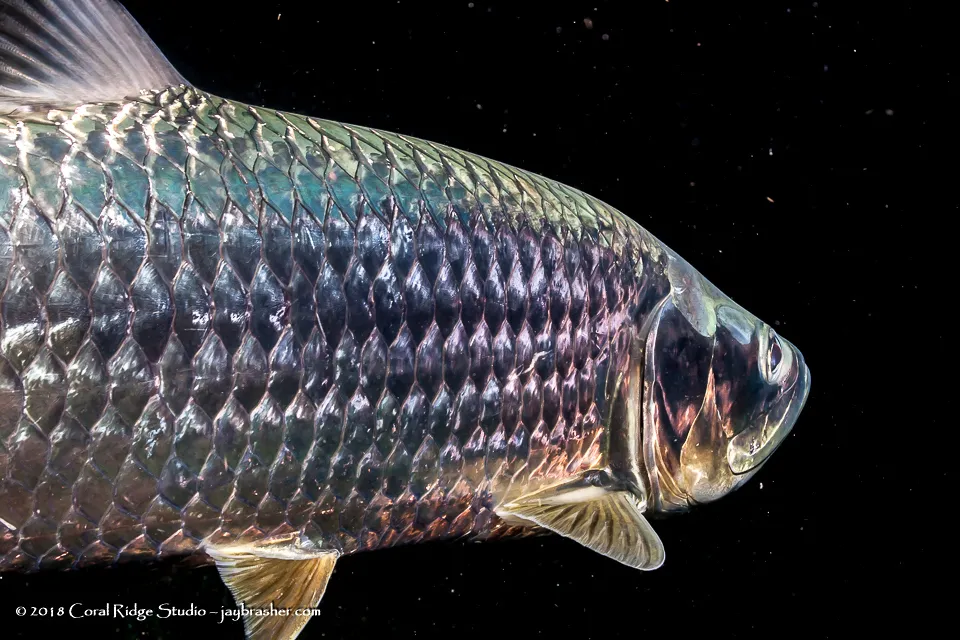 Atlantic tarpon
The tarpon has very large silver scales, a large upward-facing mouth and a long trailing filament on its last dorsal fin ray. The milkfish has small scales and a small, toothless mouth.
Environment
Coastal watersEstuariesMangroves
Tropical coastal waters around islands and continental shelves, 1–30 m deep, often entering estuaries and rivers. Young fish move to mangroves, estuaries and sometimes lakes, then return to sea to mature.
- Diet
- Omnivorous. Young fish eat algae, plankton and small invertebrates; adults also take bottom invertebrates and small fish.
Distribution
- Native
- The Indian and Pacific oceans: from South Africa to Hawaii and the Marquesas, from California to the Galápagos, north to Japan and south to Australia.
Where it's been recorded
Recorded in 57 countries: American Samoa, Australia, Bangladesh, British Indian Ocean Territory, China, Christmas Island, Cocos (Keeling) Islands, Colombia, Costa Rica, Ecuador, Egypt, Eritrea, Fiji, France, French Polynesia, French Southern Territories, Guam, India, Indonesia, Iran, Japan, Kenya, Kiribati, Madagascar, Malaysia, Maldives, Mauritius, Mayotte, Mexico, Mozambique, New Caledonia, Nicaragua, Northern Mariana Islands, Oman, Pakistan, Palau, Panama, Papua New Guinea, Philippines, Réunion, Saudi Arabia, Seychelles, Singapore, Solomon Islands, South Africa, Sri Lanka, Sudan, Taiwan, Tanzania, Thailand, Tuvalu, U.S. Outlying Islands, United Arab Emirates, United States, Vanuatu, Wallis & Futuna, and Yemen.
Records from GBIF.org, CC0 and CC BY datasets only. Few records can mean few surveys, not few fish.
Eating
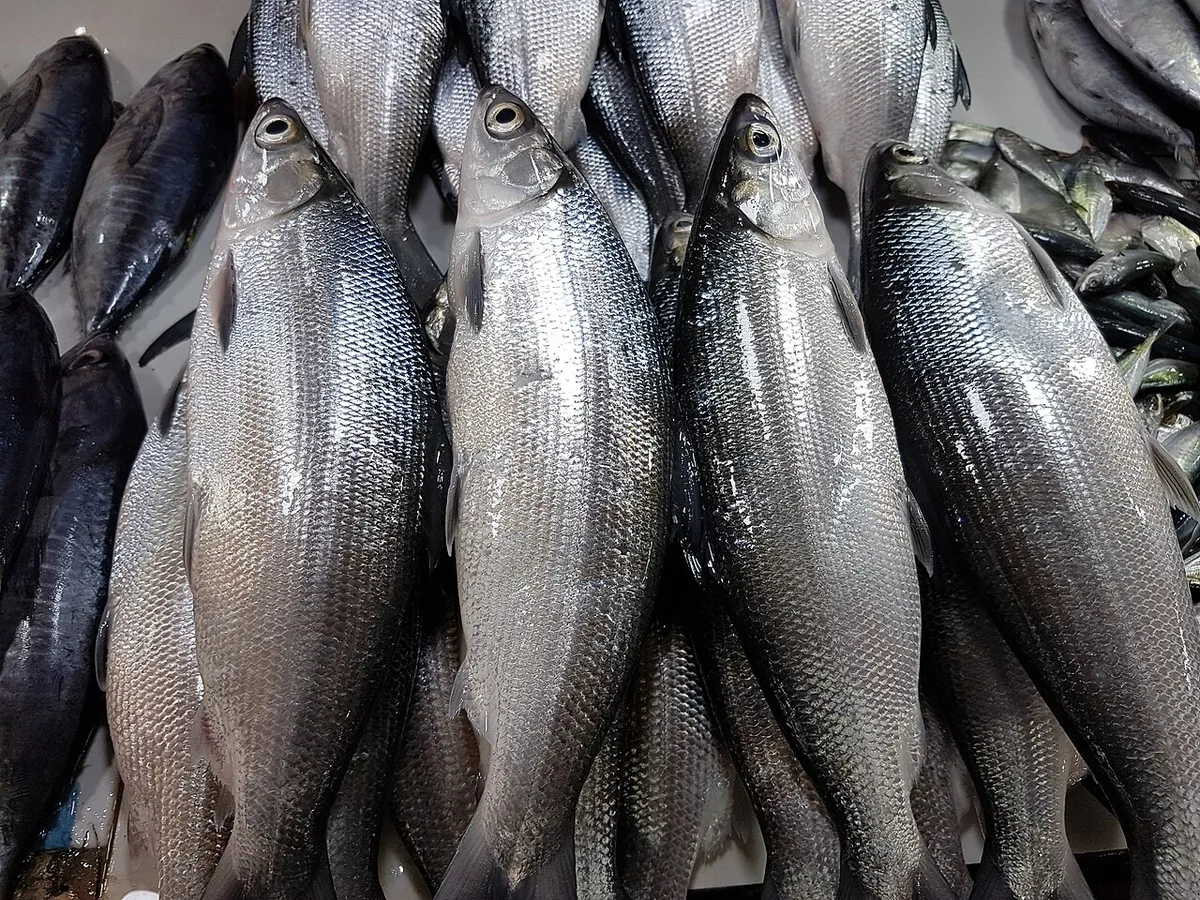
Called bangus in the Philippines. The flesh is full of fine bones, so deboned milkfish, sold as boneless bangus, is common in shops and markets. Filipinos also eat it raw as kinilaw na bangus, dressed with calamansi juice or vinegar. In Indonesia it is sold as soft-boned milkfish, pressure-cooked until the bones are tender, or smoked. In Taiwan it is the most popular fish, valued for its tender meat and low price.
Questions
- What is bangus?
- Bangus is the Philippine name for the milkfish, Chanos chanos. People often call it the national fish of the Philippines, and a Philippine government research agency does too, but the National Commission for Culture and the Arts has said that no Philippine law makes it so.
- Why is milkfish so bony, and how do people deal with it?
- The flesh has many fine bones running through the muscle, so it is much bonier than most food fish. Deboned milkfish, sold as boneless bangus, is popular in Philippine shops and markets. In Indonesia the fish is pressure-cooked until the bones turn soft.
- How much protein and fat does milkfish have?
- USDA FoodData Central lists raw milkfish at about 148 kcal, 20.5 g of protein and 6.7 g of fat per 100 g, of which 1.8 g is polyunsaturated fat. The entry does not break out omega-3 fats.
- Is milkfish farmed?
- Yes. Farming in Indonesia, Taiwan and the Philippines began about four to six centuries ago, and farms there now get most of their young fish from hatcheries because wild fry have become scarce. The Philippines led milkfish production from 2001 to 2009, until Indonesia overtook it in 2010.
- How big does milkfish get, and where does it live?
- A typical adult is about 1 m long, and the biggest reach about 1.8 m. It lives in warm Indian and Pacific ocean waters, mostly near coasts and reefs 1 to 30 m deep, and often enters estuaries and rivers. Young fish move into mangroves, estuaries and sometimes lakes before returning to sea.
Status and uses
IUCN Red List: Least Concern (LC)
Category from the IUCN Red List; it may lag the latest assessment.
Uses: Food
Taxonomy
- KingdomAnimalia
- PhylumChordata
- SubphylumVertebrata
- InfraphylumGnathostomata
- ParvphylumOsteichthyes
- GigaclassActinopterygii
- SuperclassActinopteri
- ClassTeleostei
- OrderGonorynchiformes
- FamilyChanidae
- GenusChanos
- SpeciesChanos chanos (Fabricius, 1775)
Names in other languages
Names from Wikidata and Malaysian fisheries lists. Each is tagged with its language.
| Language | Names | Source |
|---|---|---|
| Malay | Ikan susu | wikidata.org |
| Chinese | 遮目鱼, 虱目鱼, 虱目魚 | wikidata.org |
| Tamil | பால்மீன் | wikidata.org |
| Acehnese | Geumulôh | wikidata.org |
| Afrikaans | Melkvis | wikidata.org |
| Arabic | سلماني | wikidata.org |
| Balinese | Ulam susu | wikidata.org |
| Bangla | চেনোচ | wikidata.org |
| Basque | Esne arrain | wikidata.org |
| Bikol | Bangus | wikidata.org |
Show 37 more languages
| Bulgarian | млечна риба | wikidata.org |
|---|---|---|
| Cebuano | Awa | wikidata.org |
| Czech | chanos stříbřitý | wikidata.org |
| Dutch | Bandeng | wikidata.org |
| Egyptian Arabic | اسماك السلمانى | wikidata.org |
| Estonian | piimkala | wikidata.org |
| Fijian | Yawa | wikidata.org |
| Filipino | Bangus | wikidata.org |
| Finnish | maitokala | wikidata.org |
| German | Milchfisch | wikidata.org |
| Hebrew | אכנס כסוף | wikidata.org |
| Hindi | चानोस चानोस | wikidata.org |
| Iloko | Bangus | wikidata.org |
| Indonesian | Ikan bandeng | wikidata.org |
| Irish | iasc bleachta | wikidata.org |
| Japanese | サバヒー | wikidata.org |
| Javanese | Iwak bandeng | wikidata.org |
| Konkani | Gholshi | wikidata.org |
| Korean | 젖빛고기 | wikidata.org |
| Lithuanian | Pienžuvinės | wikidata.org |
| Macedonian | Млечна риба | wikidata.org |
| Madurese | Bhândheng | wikidata.org |
| Malagasy | Rononomandry | wikidata.org |
| Malayalam | പൂമീൻ | wikidata.org |
| Nauru | Ibiya | wikidata.org |
| Norwegian Bokmål | Melkefisk | wikidata.org |
| Pampanga | Bangus | wikidata.org |
| Persian | خامهماهی | wikidata.org |
| Russian | Ханос | wikidata.org |
| Sundanese | Bandeng | wikidata.org |
| Swahili | Fupefupe | wikidata.org |
| Swedish | Mjölkfisk | wikidata.org |
| Thai | ปลานวลจันทร์ทะเล | wikidata.org |
| Turkish | Süt balığı | wikidata.org |
| Ukrainian | Молочна риба | wikidata.org |
| Vietnamese | Cá măng sữa | wikidata.org |
| Waray | Bangus | wikidata.org |
More photos
Sources
Last reviewed 24 November 2026
- Milkfishen.wikipedia.org
- Chanos chanos (Forsskål, 1775)gbif.org
- Chanos chanoswikidata.org
- Chanos chanos (Fabricius, 1775)catalogueoflife.org
- FAO - Chanos chanosfao.org
- fdc.nal.usda.gov
- Milkfish – Industry Strategic Science and Technology Plans (ISPs) Platformispweb.pcaarrd.dost.gov.ph
Photo credits
- Photo 1, top of the page: Bloopityboop / Wikimedia Commons · CC BY-SA · Source
- Photo 2: Obsidian Soul / Wikimedia Commons · CC BY-SA · Source
- Photo 3: (c) Nicola Crockford, some rights reserved (CC BY) · CC BY · Source
- Atlantic tarpon, in look-alikes: (c) Jay Brasher, some rights reserved (CC BY) · CC BY · Source


Data credits
- IUCN Red List category, via GBIF (CC BY 4.0).
- Range map from records on GBIF.org (CC0 and CC BY datasets only).
- Classification from Catalogue of Life (CC BY 4.0).