Fish profile · Cichlidae
Mozambique tilapia
Oreochromis mossambicus
The Mozambique tilapia is a hardy cichlid from southeastern Africa that people have carried to tropical and subtropical waters around the world. It is a popular farmed fish and can become invasive where it has been released.
Last reviewed 18 November 2026 · 4 sources
How big?
Linear scale · hand 18 cm
- Max length
- 39 cm
- without the tail
- Max weight
- 1.1 kg
How to identify
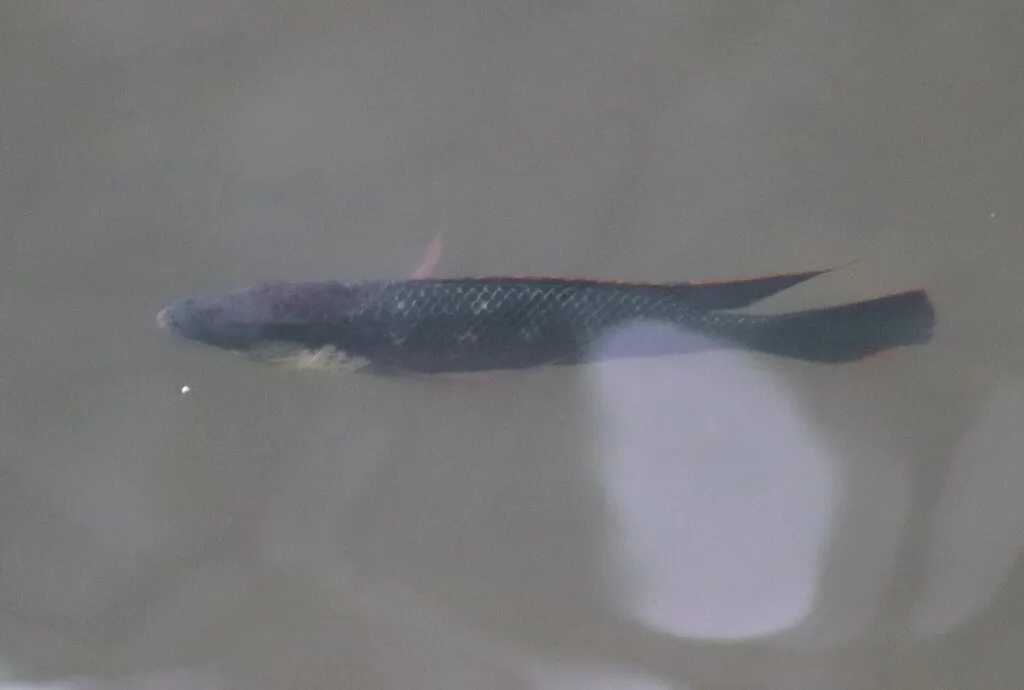
- A deep, flattened body with a long dorsal fin whose front part is spiny.
- Wild fish are a dull green or yellow, sometimes with faint bands.
Environment
- Water
- FreshwaterBrackish
Inland and coastal water. It tolerates salt water, which is one reason it is farmed.
Distribution
- Native
- Inland and coastal waters of southeastern Africa, from the Zambezi basin in Mozambique, Malawi, Zambia and Zimbabwe to the Bushman River in South Africa's Eastern Cape.
- Introduced
- Many tropical and subtropical waters around the world, including Indonesia, where a Javanese breeder helped spread it.
Where it's been recorded
Shown as rough areas to protect a threatened fish.
Recorded in 80 countries: Angola, Aruba, Australia, Bangladesh, Barbados, Botswana, Brazil, China, Colombia, Congo - Kinshasa, Cook Islands, Costa Rica, Côte d’Ivoire, Cuba, Dominican Republic, Ecuador, Egypt, El Salvador, Eswatini, Ethiopia, Fiji, French Guiana, French Polynesia, Germany, Grenada, Guadeloupe, Guatemala, Haiti, Honduras, Hong Kong SAR China, India, Indonesia, Israel, Jamaica, Japan, Kenya, Kiribati, Laos, Madagascar, Malawi, Malaysia, Martinique, Mexico, Mozambique, Myanmar (Burma), Namibia, New Caledonia, Nicaragua, Nigeria, Panama, Papua New Guinea, Philippines, Puerto Rico, Réunion, São Tomé & Príncipe, Seychelles, Singapore, Solomon Islands, South Africa, Spain, Sri Lanka, St. Barthélemy, St. Lucia, St. Vincent & Grenadines, Suriname, Taiwan, Tanzania, Thailand, Timor-Leste, Trinidad & Tobago, U.S. Virgin Islands, Ukraine, United Arab Emirates, United States, Vanuatu, Venezuela, Vietnam, Wallis & Futuna, Zambia, and Zimbabwe.
Records from GBIF.org, CC0 and CC BY datasets only. Few records can mean few surveys, not few fish.
Eating
Farmed widely. Pure Mozambique tilapia grow more slowly than other tilapia and cut into smaller fillets, so farms often cross them with other species.
Status and uses
Taxonomy
- KingdomAnimalia
- PhylumChordata
- SubphylumVertebrata
- InfraphylumGnathostomata
- ParvphylumOsteichthyes
- GigaclassActinopterygii
- SuperclassActinopteri
- ClassTeleostei
- OrderCichliformes
- FamilyCichlidae
- SubfamilyPseudocrenilabrinae
- GenusOreochromis
- SpeciesOreochromis mossambicus (Peters, 1852)
Names in other languages
Names from Wikidata and Malaysian fisheries lists. Each is tagged with its language.
| Language | Names | Source |
|---|---|---|
| Chinese | 罗非鱼, 莫三比克口孵非鯽, 羅非魚 | wikidata.org |
| Afrikaans | Bloukurper, Blou kurper | wikidata.org |
| Arabic | بلطي نيلي موزمبيقي | wikidata.org |
| Balinese | Mujair | wikidata.org |
| Bangla | তেলাপিয়া | wikidata.org |
| Divehi | ފޫޓު މަސް | wikidata.org |
| Dutch | natalbaars | wikidata.org |
| Egyptian Arabic | بلطى نيلى موزمبيقى | wikidata.org |
| Finnish | valkoleukatilapia | wikidata.org |
| German | Mosambik-Buntbarsch, Mosambik-Maulbrüter, Natal-Buntbarsch, Weißkehlmaulbrüter | wikidata.org |
Show 15 more languages
| Greek | Τιλάπια της Μοζαμβίκης | wikidata.org |
|---|---|---|
| Hebrew | אמנון מוזמביק | wikidata.org |
| Indonesian | Mujair | wikidata.org |
| Japanese | カワスズメ | wikidata.org |
| Javanese | Iwak mujaèr | wikidata.org |
| Korean | 모잠비크틸라피아 | wikidata.org |
| Madurese | Mujaèr | wikidata.org |
| Persian | تیلاپیای موزامبیکی | wikidata.org |
| Portuguese | Tilápia-de-moçambique | wikidata.org |
| Russian | Мозамбикская тиляпия | wikidata.org |
| Sundanese | Mujaér | wikidata.org |
| Swedish | Moçambique-tilapia | wikidata.org |
| Thai | ปลาหมอเทศ | wikidata.org |
| Ukrainian | Тиляпія мозамбікська | wikidata.org |
| Vietnamese | Cá rô phi đen | wikidata.org |
Sources
Last reviewed 18 November 2026
- Mozambique tilapiaen.wikipedia.org
- Oreochromis mossambicus (Peters, 1852)gbif.org
- Oreochromis mossambicuswikidata.org
- Oreochromis mossambicus (Peters, 1852)catalogueoflife.org
Photo credits
Data credits
- IUCN Red List category, via GBIF (CC BY 4.0).
- Range map from records on GBIF.org (CC0 and CC BY datasets only).
- Classification from Catalogue of Life (CC BY 4.0).