Fish profile · Pimelodidae
Pictus catfish
Pimelodus pictus
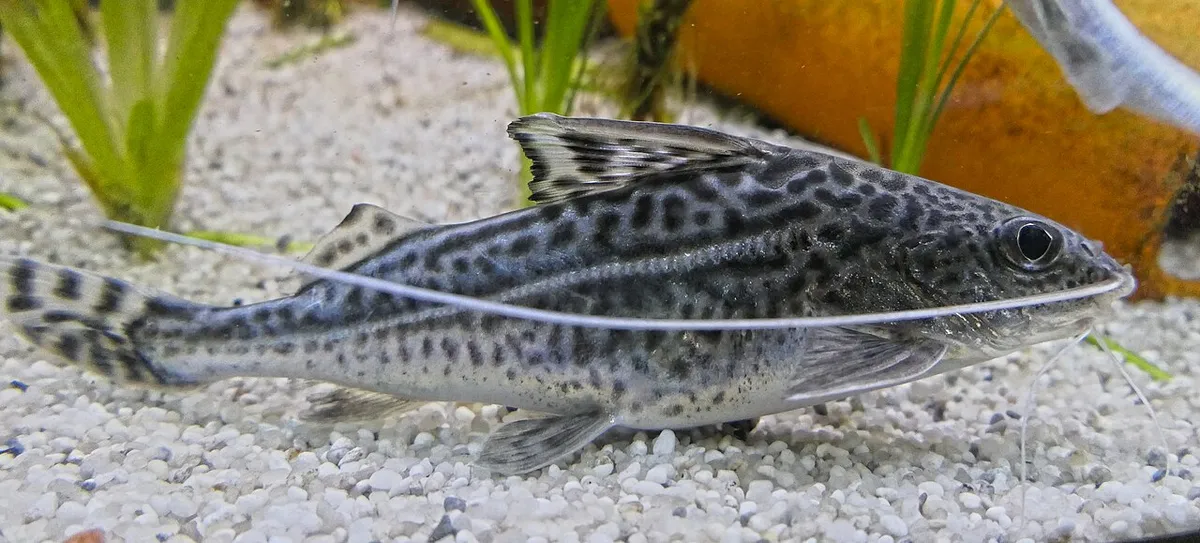
The pictus catfish is a silver, spotted catfish with very long barbels, popular in aquariums. It is an active, night-time bottom feeder that can swallow very small fish.
Last reviewed 23 November 2026 · 4 sources
How big?
Linear scale · hand 18 cm
- Max length
- 11 cm
How to identify
- Silver body with black spots and stripes.
- Extremely long barbels that can reach the tail fin, and a forked tail.
- Sharp, mildly venomous spines on the dorsal and pectoral fins.
Environment
- Water
- Freshwater
- Diet
- Omnivorous: in captivity bloodworms, insects, vegetables and prepared foods. It will eat very small fish such as neon tetras.
Distribution
- Native
- The Amazon and Orinoco river basins of South America.
Where it's been recorded
Recorded in 5 countries: Brazil, Colombia, Ecuador, Peru, and Venezuela.
Records from GBIF.org, CC0 and CC BY datasets only. Few records can mean few surveys, not few fish.
Status and uses
IUCN Red List: Least Concern (LC)
Category from the IUCN Red List; it may lag the latest assessment.
Uses: Aquarium
Taxonomy
- KingdomAnimalia
- PhylumChordata
- SubphylumVertebrata
- InfraphylumGnathostomata
- ParvphylumOsteichthyes
- GigaclassActinopterygii
- SuperclassActinopteri
- ClassTeleostei
- OrderSiluriformes
- SuborderSiluroidei
- FamilyPimelodidae
- GenusPimelodus
- SpeciesPimelodus pictus Steindachner, 1876
Types: Types of catfish
Names in other languages
Names from Wikidata and Malaysian fisheries lists. Each is tagged with its language.
| Language | Names | Source |
|---|---|---|
| Chinese | 平口油鲶, 平口油鯰 | wikidata.org |
| Bulgarian | шарено плоскоглаво сомче | wikidata.org |
| Finnish | pilkkuantennimonni | wikidata.org |
| German | Engel-Antennenwels | wikidata.org |
| Korean | 픽터스 캣 | wikidata.org |
| Persian | گربه ماهی پیکتوس | wikidata.org |
| Polish | Mandi mały | wikidata.org |
Sources
Last reviewed 23 November 2026
Photo credits

Data credits
- IUCN Red List category, via GBIF (CC BY 4.0).
- Range map from records on GBIF.org (CC0 and CC BY datasets only).
- Classification from Catalogue of Life (CC BY 4.0).