Fish profile · Doradidae
Striped Raphael catfish
Platydoras armatulus
The striped Raphael catfish is a peaceful, night-active armoured catfish of South American rivers. It is also called the talking catfish because it grunts or squeaks out of water.
Last reviewed 23 November 2026 · 4 sources
How big?
Linear scale · hand 18 cm
- Max length
- 24 cm
- without the tail
How to identify
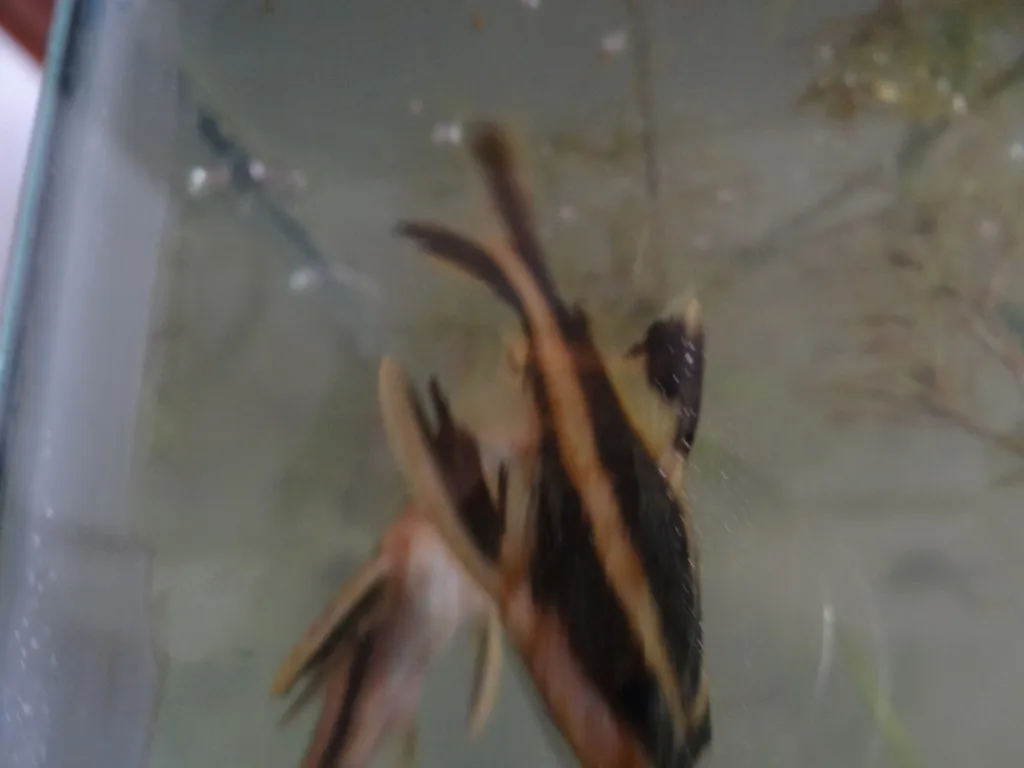
- A dark body with a pale stripe along each side.
- Rigid pectoral spines and tiny curved spines along the body.
- Young fish have bolder stripes than adults.
Environment
- Water
- Freshwater
It burrows in soft river bottoms, often on sand.
- Diet
- Molluscs, crustaceans and organic debris.
Distribution
- Native
- The Amazon, Paraguay–Paraná and lower Orinoco basins of South America.
Where it's been recorded
Recorded in 8 countries: Bolivia, Brazil, Colombia, Paraguay, Peru, Suriname, United States, and Venezuela.
Records from GBIF.org, CC0 and CC BY datasets only. Few records can mean few surveys, not few fish.
Status and uses
IUCN Red List: Least Concern (LC)
Category from the IUCN Red List; it may lag the latest assessment.
Uses: Aquarium
Taxonomy
- KingdomAnimalia
- PhylumChordata
- SubphylumVertebrata
- InfraphylumGnathostomata
- ParvphylumOsteichthyes
- GigaclassActinopterygii
- SuperclassActinopteri
- ClassTeleostei
- OrderSiluriformes
- SuborderSiluroidei
- FamilyDoradidae
- GenusPlatydoras
- SpeciesPlatydoras armatulus (Valenciennes, 1840)
Types: Types of catfish
Names in other languages
Names from Wikidata and Malaysian fisheries lists. Each is tagged with its language.
| Language | Names | Source |
|---|---|---|
| Chinese | 盔平囊鯰 | wikidata.org |
| Finnish | Juovaokamonni | wikidata.org |
| German | Liniendornwels | wikidata.org |
| Norwegian Bokmål | stripet sjokolademalle | wikidata.org |
| Persian | گربهماهی رافائل راهراه | wikidata.org |
Sources
Last reviewed 23 November 2026
Photo credits
Data credits
- IUCN Red List category, via GBIF (CC BY 4.0).
- Range map from records on GBIF.org (CC0 and CC BY datasets only).
- Classification from Catalogue of Life (CC BY 4.0).