Fish profile · Carangidae
Yellowtail kingfish
Seriola lalandi
Also called Kingfish, Kingie, Yellowtail, and Yellowtail amberjack
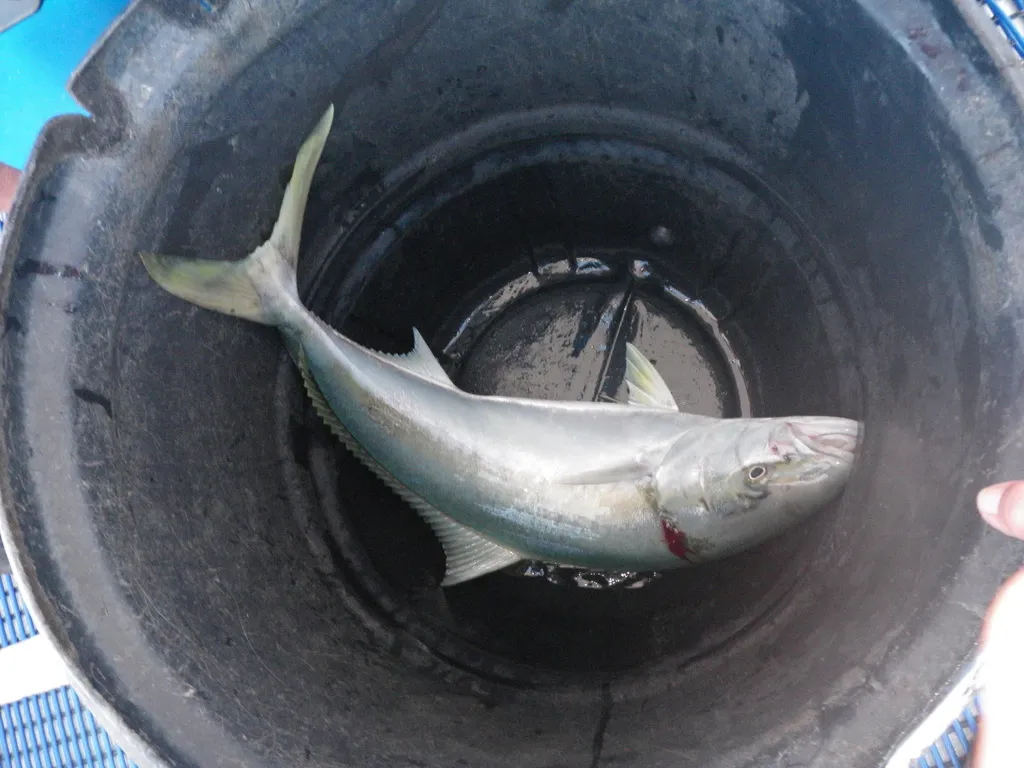
The yellowtail kingfish is a big, powerful, streamlined fish with a yellow tail and a yellow stripe along its side. It is a highly prized game fish and is also farmed, notably in South Australia.
Last reviewed 13 November 2026 · 4 sources
How big?
Linear scale · person 170 cm
- Max length
- 250 cm
- usually 100 cm
- Max weight
- 96.8 kg
How to identify
- Dark blue to greenish-blue above, silvery white below
- A yellow to bronze stripe from the snout through the eye and along the middle of the side
- Yellowish, strongly forked tail on a narrow tail base
- Young fish are yellow with black bands
Environment
- Water
- Saltwater
- Depth
- 0–50 m
Coastal, inshore and offshore waters, usually 0 to 50 m deep. Adults gather in big shoals around deep reefs, rocky outcrops, pinnacles and offshore islands, and around jetties and pylons in bays and harbours. Young fish form schools of hundreds and sometimes enter estuaries.
- Diet
- Small fish, squid and crustaceans, including snails, bivalves, cuttlefish, crabs, prawns and krill.
Distribution
- Native
- From the Capricorn Group on the Great Barrier Reef in Queensland, round southern Australia to about Shark Bay in Western Australia, including south-eastern Tasmania. Common around Lord Howe and Norfolk Islands.
Where it's been recorded
Recorded in 27 countries: Argentina, Australia, Brazil, Chile, Colombia, Costa Rica, Ecuador, French Polynesia, French Southern Territories, Guatemala, Haiti, Japan, Mexico, Mozambique, New Caledonia, New Zealand, Norfolk Island, Panama, Philippines, Réunion, South Africa, South Korea, St. Helena, Thailand, U.S. Outlying Islands, United Kingdom, and United States.
Records from GBIF.org, CC0 and CC BY datasets only. Few records can mean few surveys, not few fish.
Status and uses
Taxonomy
- KingdomAnimalia
- PhylumChordata
- SubphylumVertebrata
- InfraphylumGnathostomata
- ParvphylumOsteichthyes
- GigaclassActinopterygii
- SuperclassActinopteri
- ClassTeleostei
- OrderCarangiformes
- SuborderCarangoidei
- FamilyCarangidae
- GenusSeriola
- SpeciesSeriola lalandi Valenciennes, 1833
Names in other languages
Names from Wikidata and Malaysian fisheries lists. Each is tagged with its language.
| Language | Names | Source |
|---|---|---|
| Chinese | 黄条鰤 | wikidata.org |
| Afrikaans | Geelstert | wikidata.org |
| Armenian | Կալիֆոռնիական դեղնապոչ | wikidata.org |
| Bulgarian | жълтоопашата кехлибарена риба | wikidata.org |
| Czech | kranas americký | wikidata.org |
| Finnish | keltapyrstöpiikkimakrilli | wikidata.org |
| French | Sériole Chicard | wikidata.org |
| Greek | Μαγιάτικο της Αυστραλίας | wikidata.org |
| Hebrew | סריול לננדי | wikidata.org |
| Japanese | ヒラマサ | wikidata.org |
Show 4 more languages
| Korean | 부시리 | wikidata.org |
|---|---|---|
| Persian | عنبرماهی دمزرد | wikidata.org |
| Russian | Жёлтохвостая лакедра | wikidata.org |
| Spanish | Medregal Rabo Amarillo | wikidata.org |
Sources
Last reviewed 13 November 2026
- Seriola lalandifishesofaustralia.net.au
- Seriola lalandi Valenciennes, 1833gbif.org
- Yellowtail amberjackwikidata.org
- Seriola lalandi Valenciennes, 1833catalogueoflife.org
Photo credits
Data credits
- IUCN Red List category, via GBIF (CC BY 4.0).
- Range map from records on GBIF.org (CC0 and CC BY datasets only).
- Classification from Catalogue of Life (CC BY 4.0).